 VetoDossier
Cat health record: your cat's whole life in one digital record
Practical guide Updated 8 November 2026 · Sources: service-public.gouv.fr, I-CAD, French Ministry of Agriculture, Anses, WSAVA
A cat's health record is often a little booklet handed over at the first vaccination, then forgotten in a drawer. It is never there on the day it is needed: the cattery asks to see it, or a vet who has never met the cat goes looking for it. This page sets out what a cat's health record should contain and what changes when it goes digital. The VetoDossier record is free.
What a cat's health record should contain
Who the cat is. The record gives its name, date of birth and coat colour, and above all its microchip number. In France, a cat over seven months old must be identified, and so must any cat that changes hands, whatever its age. The microchip is implanted, or the tattoo applied, by a vet or an authorised tattooist, who registers the cat on the national database kept by I-CAD, the French pet identification register. The number never changes, and it is what links the cat to everything that concerns it. Our guide to the microchip number (in French) explains what it gives access to.
Vaccinations. According to Anses-ANMV (figures for 2014-2018), the feline vaccines sold in France cover five diseases: panleukopenia (called typhus in France); cat flu, or coryza (calicivirus and herpesvirus); feline leukaemia; rabies; and chlamydiosis. The WSAVA guidelines published in 2024 class the vaccines against panleukopenia and cat flu as core vaccines for every cat. For each injection, the record keeps the name of the vaccine, the date and the vet's stamp. You will find no schedule here: how often boosters are given is for your vet to decide, depending on the cat's age and lifestyle. Our guides to typhus and coryza are in French, as are those on cat vaccines and kitten vaccination, which set out what the published recommendations say. The guide to the vaccination record (in French) explains what that part of the record should show.
The rest of its medical history. The record keeps the date and the product name of every worming or flea treatment, the date the cat was neutered, prescriptions, blood tests, imaging, invoices and insurance claim forms. Taken one at a time, these papers look minor. Together they make up the cat's history, the one the next vet will read. Our guides to worming, fleas and neutering are in French.
A European pet passport, if it travels. A cat travelling to another EU country needs a microchip (a legible tattoo done before 3 July 2011 is still accepted), a European pet passport issued by a vet, and a valid rabies vaccination. Keep the original. The digital record only holds a copy.
Why keep a cat's health record digitally
An indoor cat sees little of the vet. Several years can pass between two visits, and in the meantime the papers end up scattered: the prescription at the bottom of a bag, the booklet under a pile of post, the invoice somewhere in an inbox. When the question of a booster comes up, a record with the date written down is worth more than a three-year-old memory.
And then there are the days when the booklet is not to hand. In an emergency on a Sunday, the out-of-hours vet starts from an empty file. The cattery wants to see the vaccinations before it will take the cat in. After a move, the new clinic knows nothing about the cat. The digital record is a copy you carry with you. Whoever is looking after the cat can read it, and so can a vet if you give them access.
How to fill in the VetoDossier record
Your own photos. The kitten's booklet, the invoice for the neutering, the prescription from the last bout of cat flu: one photo with your phone is enough. The record straightens the page. You choose the category and correct the title or the date if need be. A file that is already digital is added the same way.
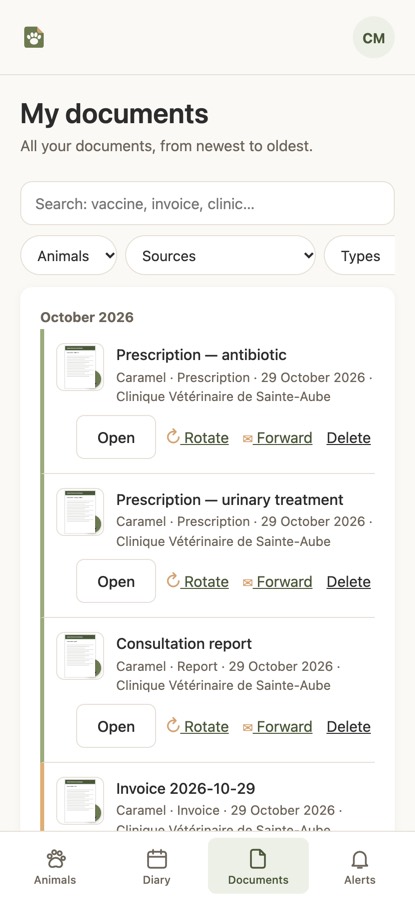
Your record address. The record has an email address of its own, along the lines of firstname.surname@vetodossier.com. Give it to your vet, the cattery and your insurer as your contact email. The first time someone writes to it, you approve the sender. From then on, their attachments go into the record, and the sender has no account to open. The record address page (in French) explains how it works.
Your clinic, if it has joined. It sends its documents to you directly, with nothing more than your phone number, and if you had no record, the first document it sends creates one. An “Added by you” label marks what you uploaded yourself and sets it apart from what a clinic sent.
Your record reminds you of the treatments you declare, wormers and flea and tick treatments included, and of the vaccine booster your clinic notes if it has joined. The record opens in any web browser. There is also an app for Android, on Google Play, and for iPhone, on the App Store. The iPhone and Android apps are in French for now; the English version works in any browser, including on your phone. Both apps are listed on the French stores, so they may not appear if your store account is registered in another country.
The cat health record app page shows what the app displays for a cat and how to sign in. If you would also like something on paper, there is a printable cat health record (in French), a free PDF you download and fill in by hand. Once its pages are filled in, you photograph them into the record like any other document.
Your cat's emergency card and its QR code
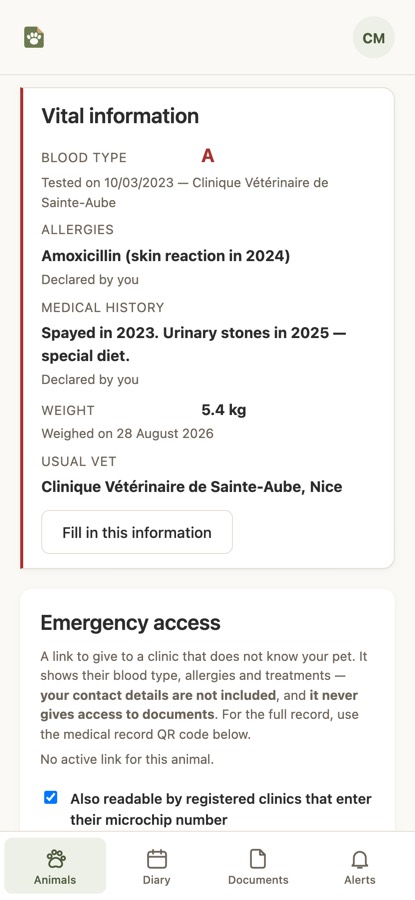
A vet who sees your cat as an emergency wants to know, quickly, anything that would change their decision: a blood type that has already been tested, a known allergy, the treatment the cat is on. The VetoDossier emergency card fits on a single page. A link or a QR code opens it, and nobody has to create an account to read it. A clinic that has joined VetoDossier can also read it by typing in your cat's microchip number, and you are told when that happens. It shows neither your name nor your phone number. The card itself is in French: a blank field reads “Non renseigné” (not provided), never “nothing to report”. Cats have three blood types, A, B and AB, and no others; human blood groups do not apply, as our guide to blood types in cats (in French) explains. Our emergency card guide (in French) sets out what belongs on it, and what does not.
When your cat changes vet, its record goes too
Your cat's record is not tied to any clinic. If a clinic that has joined VetoDossier asks for access to the record using the microchip number, the request comes to you, and nothing opens without your say-so. For a vet the cat will see only once, a QR code for the record, valid for seven days, is enough. Make it before you set off: it stays on the phone that created it, and it can be shown even without a signal. Both subjects have a page of their own: the shared medical record (in French) and changing vet (in French).
Key points
- How often your cat is vaccinated and wormed is decided with your vet, never from a web page.
- A cat over seven months old must be identified, and so must a cat that changes hands, whatever its age. To travel within the EU, it needs a European pet passport issued by a vet.
- You fill the digital record with your photos and your record address. It earns its keep on the day the booklet has been left at home.
- Microchip, vaccinations, worming, neutering, treatments, reports, lab results, invoices: all of it has a place in a cat's record.