 VetoDossier
Dog health record: one digital record for your dog's whole life
Practical guide Updated 8 November 2026 · Sources: service-public.gouv.fr, I-CAD, French Ministry of Agriculture, WSAVA, Anses
A puppy comes home from the breeder or the shelter with its health booklet. The booklet goes to its first vet, then to another after a move, and often ends up in the glovebox with two pages of vaccine stickers and a prescription folded into quarters. A digital health record keeps all of it in one place: when the clinic sends the document, it lands in the record under the right date, without you having to do anything.
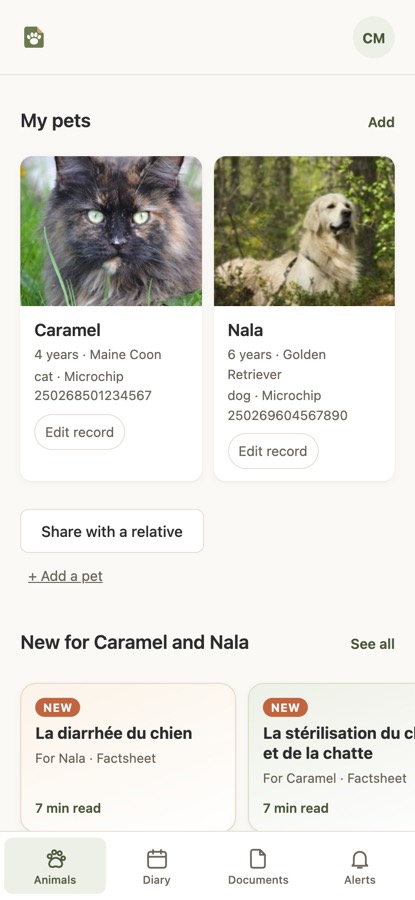
What goes in a dog's health record
Vaccinations. At each injection, the vet sticks in the vaccine label and writes the date. Depending on the dog, the vaccines protect against distemper, parvovirus, infectious canine hepatitis, leptospirosis or rabies. Which ones, and how often, is for your vet to decide, based on your dog's lifestyle. The record only has to show which vaccine was given, and when. What the published guidelines say is set out in our pages on dog vaccines (in French) and on puppy vaccination (in French); what the vaccination page should show is covered in the guide to the vaccination record (in French).
Worming and parasite treatments. A dog that runs through woodland or stays in boarding kennels does not follow the same programme as a town dog. The product and the date of each dose belong in the record. The intervals published by the European reference guide are described in our page on worming and parasite treatment for dogs (in French), and fleas have a page of their own: fleas in dogs (in French).
Then there is identification: the microchip or tattoo number and the document from the national register, which you will be asked for at boarding kennels, when you travel, and on the day your dog goes missing.
Procedures and treatments. The report on a castration or a spay, the one on knee surgery, the prescription for long-term epilepsy or arthritis treatment: this is what a vet will read before prescribing anything.
Lab results, imaging, invoices. A blood test or a hip X-ray is useful on the day it is done, and even more so three years later, when the results need comparing. Invoices and insurance claim forms do not treat anything, but if your dog is insured, they are what you need to claim from your insurer.
Your dog's official papers: identification and passport
In France, identification is compulsory for every dog over four months old, and for a dog of any age before it is sold or given away. It is done by a vet (or by an approved tattooist, for a tattoo) and recorded in the national register of domestic carnivores, run by I-CAD. That register links your dog's number to your name.
You need a European pet passport to travel with your dog to another European Union country. It is issued by a vet, and the dog must be microchipped and vaccinated against rabies, with the vaccine recorded in the passport. Allow several weeks: a first rabies vaccination is only recognised from 21 days after the injection, and some countries ask for more.
Keep both originals safe; the record holds only a legible copy of them.
Why a digital health record for your dog
The paper booklet is at home on a Sunday evening, when your dog swallows something on a walk and the out-of-hours vet asks what medication it is on. A dog also sees several vets in its life: the local clinic, the one in the new town, a specialist for a limp. Each of them keeps its own file. A digital record solves that particular problem: one place, on your phone, where every document arrives under its own date.
How the VetoDossier record fills up
Through your clinic. If it uses VetoDossier, it sends the prescription, the report, the invoice or the insurance claim form from its clinic area, with nothing more than your phone number. The document goes into your dog's record, under its date and in its category.
Through your record address, if it does not. Every record has its own email address, along the lines of firstname.surname@vetodossier.com, which you give your clinic as your contact email. The first time the clinic writes, you approve the sender; after that, its attachments arrive in the record without the clinic changing the way it works. The details are on the page about the record address (in French).
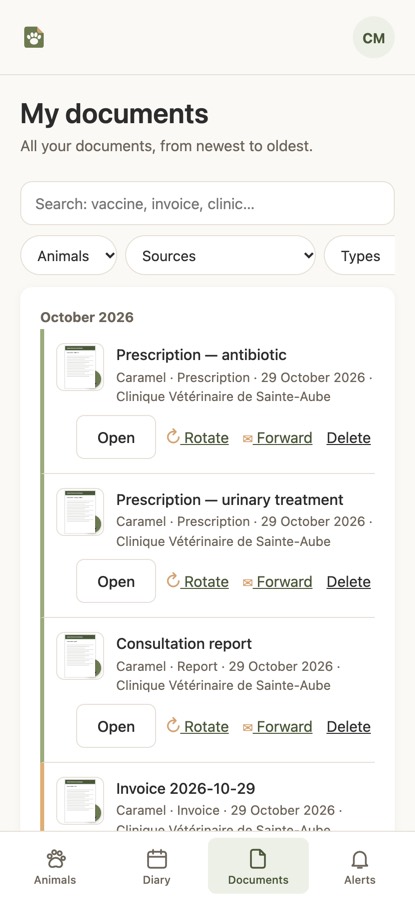
By you, for everything else. The puppy's booklet, the breeder's certificate, a prescription from two years ago: you photograph them with your phone. Each page is straightened and cleaned up, then filed in one of the record's categories. A document you have added always carries the label “Added by you”, so a vet can tell what came from a clinic and what came from you.
A vaccine booster noted by your clinic, a treatment in progress, a worming dose you have declared: your record reminds you of them. When your insurer asks for a claim form, you forward it from the record, by email or through your phone's share sheet.
The same record is available as an app for Android and iPhone: the page on the dog health record app explains what it shows and how to sign in. The iPhone and Android apps are in French for now; the English version works in any browser, including on your phone. And if you would rather keep paper, a printable dog health record (in French), a free PDF, can be downloaded from its own page: you fill in its blank tables by hand, and a photo of each page can later go into the digital record.
An emergency card, readable from a QR code
When a passer-by brings in your dog after it has been hit by a car, the vet on duty has no time to read a file. That is why every animal in the record has an emergency card: one page of vital information, including the blood type if it has been tested (DEA 1 positive or negative in dogs). It opens from a link or a QR code, and nobody needs an account to read it; its headings are in French, for the vet who reads it. The QR code is made for your dog's collar tag. The card does not show your name, phone number or address, because anyone can photograph a collar. A clinic registered on VetoDossier that types in your dog's microchip number sees the same card straight away, and you are told when it does. What to put on the card, and what is better left off, is covered in the guide to the emergency card and its QR code (in French).
When your dog changes vet: the shared medical record
A clinic registered on VetoDossier can ask for access to your dog's record using its microchip number. You receive the request, and you accept or refuse it. If you do not answer, nothing opens. You can see which clinic has opened the record and when, and you can withdraw its access whenever you like. This is the shared medical record (in French).
The microchip number works as the key because it never changes: its guide (in French) explains what it opens and what it does not reveal. For a vet who does not use VetoDossier, you can also share the record through a link that is valid for seven days.
Key points
- A dog's health record brings together vaccinations, worming and parasite treatments, identification, procedures, treatments, lab results, invoices and insurance claim forms.
- In France, identification is compulsory for every dog over four months old and before any change of ownership; you need a European pet passport to travel within the European Union.
- With VetoDossier, your clinic sends documents with just your phone number, or to your record address; you add the rest as photos, and “Added by you” marks what you have added.
- The emergency card is for the vet who has no time to read; the shared medical record is for the vet who does.