A digital health record that doesn’t depend on any vet software
Your clinics may change, but your pet’s record stays. Only you decide who can read it.

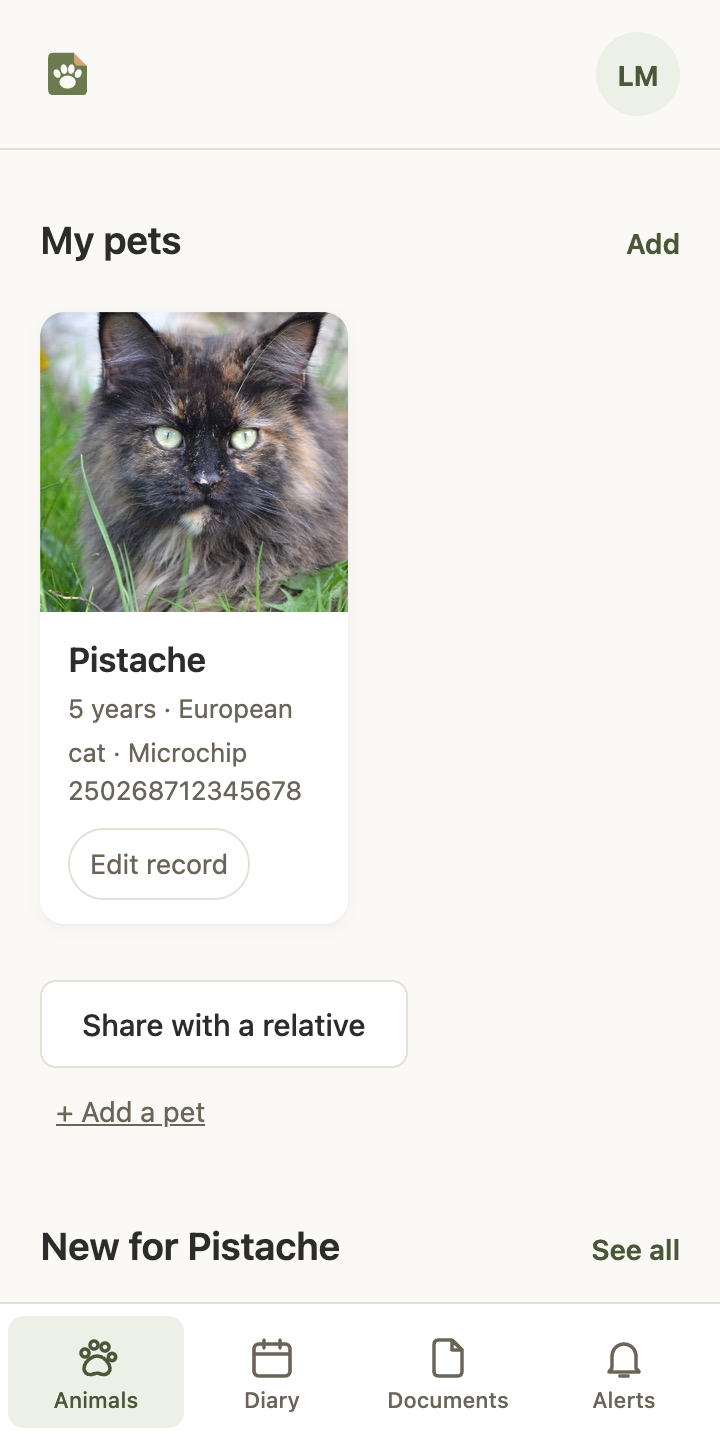
It fills itself in. Your clinic adds invoices, prescriptions and reports to it using nothing but your phone number, whatever software it runs. Your health record brings your pet’s complete veterinary file together online, and it keeps track of everything for you.
It is free for owners and clinics alike.
It works on the web, on the clinic’s computer (Mac and Windows) and straight from your smartphone. The apps are on Google Play and the App Store, in French for now.
Which area is yours?
Breeder
Your registers, in the format of the entries required by the decree of 19 June 2025, built from the procedures your vets record.
My breeding businessShelter or rescue association
The same registers, adapted to taking animals in and rehoming them: arrivals and departures, health monitoring, behavioural assessment.
My shelterVeterinary clinic
You send documents with just the client’s phone number, whatever software you use.
Clinic area Create your area (form in French)Who we are
VetoDossier is the shared medical record app for pets. Here is what that means, in four points.
1. For owners
A record that keeps track of everything: invoices, prescriptions, reports, and reminders for vaccines and treatments. It lasts for life, whoever the vet.
2. For clinics
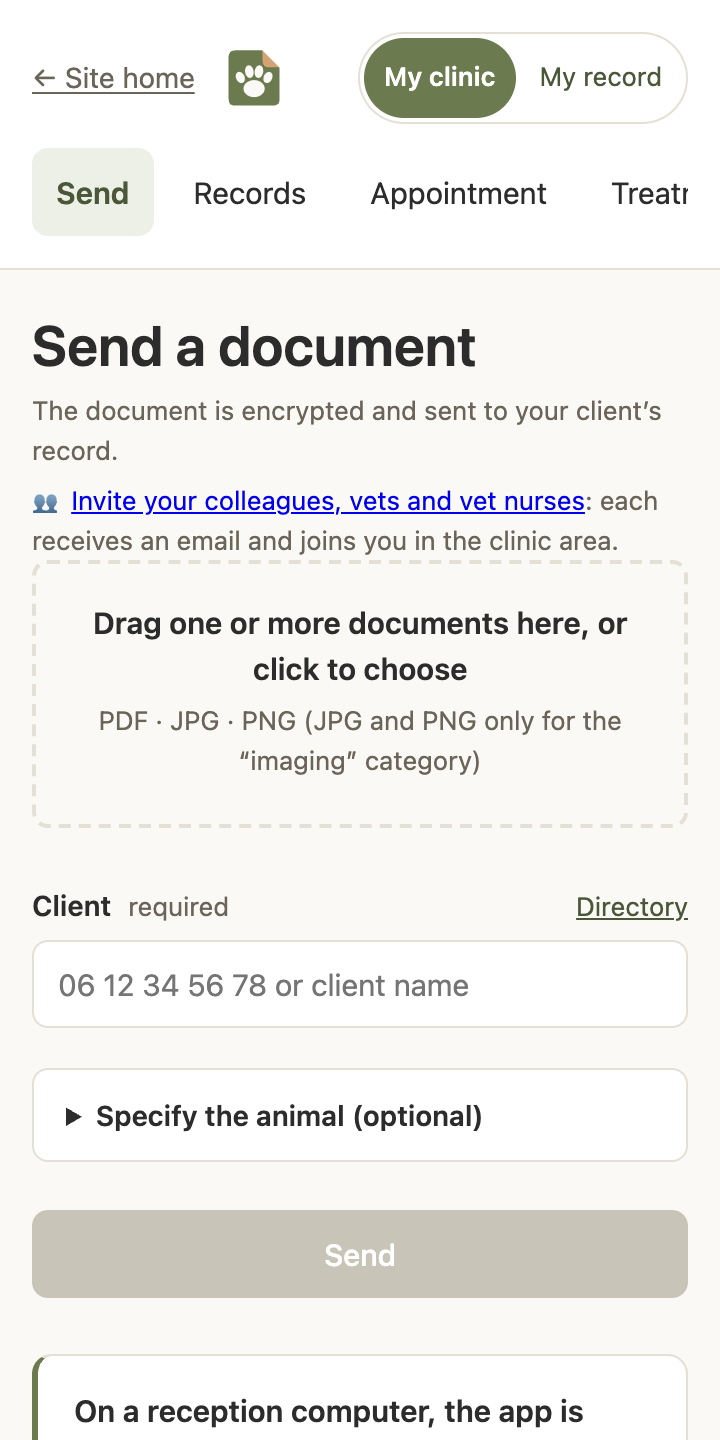
About ten seconds per document: a file, a scan or a photo, the client’s number, then send, from the reception computer or a smartphone. The client doesn’t have to set anything up.
3. The shared record
A clinic can ask for the record of an animal it has never seen, using its microchip number. It can read the emergency card straight away, and only you can open the full record. You can see who has looked at what.
4. Emergencies
The emergency card and the record can be shared in moments with whoever you choose, even a vet without an account, by link or by QR code.
VetoDossier is independent of any veterinary software and of any software vendor. It is free for clinics and owners alike. Your data stays yours: you can export it or delete it at any time.
How it works
Your vet treats your pet
At reception, the clinic sends the documents from the consultation using your phone number, the one it already has on file. You don’t have to do anything.
The record fills itself in
Invoices, prescriptions, reports and insurance claim forms arrive in your pet’s record, sorted and dated.
You have nothing left to remember
Appointments, vaccine boosters, treatments: your record reminds you of them at the right time.
The shared medical record: it follows your pet, not the clinic
Your pet’s medical record doesn’t live in one clinic’s software, where it would stop at the door. It lives in your health record, and you decide who can read it.
Change clinic and it comes with you
Moving to a new vet, going on holiday, dealing with an emergency? From your record, you open the full medical record to the clinic of your choice, and you withdraw access whenever you like. A clinic that asks to see the record never gets the full record without your answer. And if the animal moves to a new home, its record can go with it, so the new owner doesn’t start from a blank page.
All the documents in one place
Invoices, prescriptions, reports, insurance claim forms: your pet’s complete veterinary file, sent straight from your clinic and there whenever you need it, on your phone or your computer. The documents are the clinic’s own, so a French prescription stays in French. You can add your own as well: photos of the paper booklet, old invoices, lab results.
Each animal has its own page
Dogs, cats… each one has its own record, with its documents, appointments and treatments. You add your animals yourself, whenever you like.
An alert for every document
An alert appears in your record each time your vet adds a document. An appointment moved, a treatment changed? You hear about that too, with the name of the clinic.
A reminder for every dose
An antibiotic for eight days, morning and evening? Your record shows sixteen reminders, not one fewer, right up to the last dose. You give the treatment and it keeps count.
Your data, protected
Documents are encrypted on our servers, with a French hosting provider. A clinic can only see them if you allow it, and you can withdraw that permission whenever you like. If you delete your account, everything is erased: documents, animals, appointments. Copies you have passed on to someone yourself stay with that person, because they have become their data.
Sharing in one step
A new vet, an out-of-hours clinic, an insurer? Share the record with whoever you choose through a link you can revoke whenever you like, which even a vet without an account can read. Your pet’s emergency card also fits in a QR code.
How much does it cost?
Nothing, for owners: the record, the documents and the reminders are free. You won’t even be asked for a bank card.
The record that keeps track of everything for you
You won’t forget a vaccine, a treatment or an appointment again, because your record reminds you of them:
- Appointments and vaccine boosters: a month before, a week before and the day before. One button adds them to your calendar.
- Treatments: you get a reminder for every dose, from the first day of the prescription to the last.
- Change of plan? If the clinic moves the appointment or adjusts the treatment, your reminders follow automatically.
These reminders don’t rely on your memory. They come from what your vet actually recorded, which is why they are right.
Android
The VetoDossier app is on Google Play:
download the app ›
iPhone
It is on the App Store too.
The iPhone and Android apps are in French for now; the English
version works in any browser, including on your phone. They are
listed on the French App Store and Google Play, so an account
from another country may not find them.
Veterinary clinics: join VetoDossier
The client’s phone number is all you need. Their documents go out from reception and their record sets itself up. There is no file to open and no email address to copy out.
“Are you on VetoDossier?” “No.” “I’ll send it to you, then.”
Your clients come back
Vaccine reminders follow from what you record. A month before the due date, your client’s record starts reminding them, and the animal comes back to see you.
Fewer missed appointments
Every appointment you book sets off its own reminders, a month before, a week before and the day before, and your client can add it to their calendar.
Better adherence to treatment
An antibiotic over ten days? The record reminds the owner of every dose, from the first day to the last, without you having to chase them.
No extra work
Reminders are created automatically from what is recorded at reception, and they correct themselves if you move an appointment or stop a treatment.
Sending takes about ten seconds
A file, a scan or a photo, the client’s number, then send, from the reception computer or straight from a smartphone. You can send several documents at once, each with its own category, a client directory suggests names as you type, and you have an hour to cancel if you make a mistake. The client receives it instantly.
On your computers, with your team
There is a desktop app for Mac and Windows, in French, and the same clinic area on the web, where vets and vet nurses work together. VetoDossier sits alongside your practice software, whatever it is, so there is no integration to install.
See you in Lille. VetoDossier will be at AFVAC Le Congrès, Lille Grand Palais, from 26 to 28 November 2026, on stand S5 in the Avenue des Start-up. We are a candidate for the Prix de l’Innovation Vétérinaire 2026. Come and see us on the stand.
Frequently asked questions
How do I get the documents my vet sends me?
You have nothing to do. At the clinic, your vet sends the documents using your phone number. They appear in your pet’s record, and an alert shows in your record each time a document is added. Your account is created with your first document, and you can also sign up on your own today. If your vet doesn’t use VetoDossier yet, photograph their documents yourself, straight onto your pet’s page. It’s quicker than keeping paper; it’s simply a new habit to get into.
My vet doesn’t use VetoDossier. How can I get their documents into my record?
Your record has its own email address, in the form firstname.lastname@vetodossier.com, shown in your record. Give it to your clinic as your contact email, in place of your usual address. Every document the clinic sends you by email then arrives in your record: the first time, you confirm the sender, and after that everything is filed automatically. The clinic has nothing extra to do and doesn’t change the way it works. All about the VetoDossier address (in French) ›
How can I see my pet’s veterinary file online?
Open your record on vetodossier.fr. You will find your dog’s or cat’s veterinary file there (invoices, prescriptions, reports, appointments and treatments), filled in by the clinics that look after your pet, and by you for anything older. You sign in with your phone number or email address and your password.
What is the difference between a health record and a veterinary file?
The health record follows the animal’s day-to-day life: vaccines, appointments, treatments. The veterinary file gathers the clinics’ documents: reports, prescriptions, invoices. In VetoDossier the two live together. Your clinic feeds the file, and your record reminds you what needs doing.
Is VetoDossier free?
Yes, for everyone: the owner’s record and the clinic area alike. Creating a record and receiving documents and reminders costs nothing. If that ever changes, you will be told beforehand.
Is VetoDossier an app? Which devices does it work on?
VetoDossier works on the web, with nothing to install, and it is independent of any veterinary software. On your smartphone, you can add the record to your home screen from the browser and use it like an app. Clinics also have a desktop app for Mac and Windows, which is in French. It is the same record everywhere.
When is my dog’s or cat’s vaccine booster due?
As a rule, the first booster comes a year after the primary vaccination, then at intervals that depend on the vaccine and on the animal’s lifestyle. Only your vet can set the right schedule. If your clinic uses VetoDossier, the booster date is recorded at reception, and your record reminds you a month before, a week before and the day before.
How often should I worm my cat or dog?
It depends on the animal’s age, lifestyle and surroundings. Vets most often recommend worming an adult several times a year, and a young animal more often. Ask your vet what suits your pet. When the treatment is recorded in VetoDossier, your record reminds you of every dose.
How can I stop forgetting my pet’s treatments?
When a treatment is recorded in VetoDossier, by your vet or by you if it was prescribed elsewhere, your record creates a reminder for every dose, from the first day to the last. If the treatment is changed or stopped, the reminders follow, so there is nothing for you to manage.
Is my data protected?
Yes. Documents are encrypted on our servers, with a French hosting provider, and a clinic can only see them if you allow it. Deleting your account erases your data: documents, animals, appointments, treatments. There is one caveat, so that the promise is accurate rather than merely reassuring. Copies you have passed on yourself, to the new owner of an animal you have rehomed or to someone who followed the record with you, stay in that person’s record. They are now that person’s data, and we cannot take them back. The details are in our privacy policy (in French).
Does VetoDossier replace the paper health booklet?
No, it adds to it. The paper vaccination booklet and the European pet passport remain your pet’s official documents. VetoDossier keeps everything else (invoices, prescriptions, reports, reminders) safe from loss and available wherever you are.
I’m a breeder: can VetoDossier keep my compulsory registers?
Yes, free of charge. The breeder area keeps the health register, where each procedure your vet records becomes a dated line, and the animal movements register, with your litters and their lineage. Both print as PDFs for an inspection, in the format of the entries required by the decree of 19 June 2025. Kennels and catteries have the same obligations and use the same area. Our page for breeders (in French) tells you more.
Is a digital breeding register accepted?
No regulation requires paper. What the rules demand is a register kept in order and in date sequence, that cannot be rewritten, that can be shown to the inspection services and that is kept for three years. A digital tool that meets these conditions is therefore acceptable. In any case, from 1 January 2029 the movements register for dogs, cats and ferrets will be the one kept on I-CAD, the French national pet identification register. Our comparison of paper, spreadsheet and digital registers (in French) goes through each requirement.
Dog and cat breeders: what changed with the decree of 19 June 2025?
The decree replaced the decree of 3 April 2014 on 3 July 2025. It redefines the entries required in the two compulsory registers and removes the concessions small breeders used to have: a single litter a year no longer exempts you from having a vétérinaire sanitaire, an officially accredited vet. Two deadlines follow. Health data must be sent to the national register from 1 January 2027, and the movements register moves to I-CAD on 1 January 2029. Our regulatory guides (in French) cover each obligation, with official sources.
I’m a vet: how do I join VetoDossier?
You create your clinic area (registration form in French) in a few fields. We send a code to the clinic’s professional email address, a person reviews the request, and then your area is activated. After that, sending a record takes as long as typing a phone number. It is free for clinics.
Can my new clinic see my pet’s history?
Yes, if you allow it. From your pet’s page, you open the full record (documents, treatments, vital information) to the clinic of your choice, for 7 days or permanently. Only that clinic has access, and you can withdraw the permission at any time.
Can a clinic see the record without my consent?
Not the full record. Without your permission, a clinic sees only what it has sent you itself. Any request for access comes to you in your record, and you are the one who answers. Every consultation is entered in a log that you can read. There are two exceptions, and both concern only the emergency card. A registered clinic that enters your pet’s microchip number can read the card straight away. It never sees your contact details or any document, each reading is shown to you with the clinic’s name, and you can switch this off for each animal. And anyone who holds the card’s link or QR code can read the vital information without having to ask. That is exactly what it is for on the night of an emergency, and you can revoke the link at any time.
I’m adopting an animal: can its record come with it?
Yes. The person handing the animal over passes on its record, choosing document by document what to give you. If they don’t use VetoDossier yet, you create your pet’s page and ask for the transfer. The request goes back to the last person who actually held the record, and only they decide. Without their answer, nothing is passed on to you.
How do I share my pet’s record with a vet?
There are two ways. If the clinic uses VetoDossier, it sends you an access request from its clinic area: you get an alert, open your record, and accept or decline. If it doesn’t, show the clinic your pet’s emergency card, a link and a QR code that open without an account on any phone.
My vet doesn’t use VetoDossier: does that change anything?
Your record works all the same. You add the documents you have yourself (photos of the paper booklet, invoices, lab results), and you can show the emergency card to any vet. What changes is this: documents added by a registered clinic carry the seal of their origin, and your own additions do not.
What is the microchip number for in VetoDossier?
It is a unique reference for finding a record. With this number, a registered clinic can read your pet’s emergency card and ask for access to its record without ever learning anything about you: not your contact details, and not your documents until you have answered. The number you enter is your own declaration, and we are not connected to the national register. If there is a dispute over who owns an animal, the keeper named on I-CAD is the one who counts, never our app.
What is the emergency card, and what does the person who opens it see?
It is a page anyone can open without an account, by link or by QR code, and you can put it on your pet’s collar tag. It shows what matters when time is short: identity, weight and the date it was taken, allergies, medical history, current treatments, blood type. It does not show your name, your phone number or your address. A button simply lets the person alert you in your record. You can revoke the link at any time.
What is my dog’s or cat’s blood type for?
It saves time on the day a transfusion is needed. The systems differ between species: A, B or AB in cats, DEA 1 positive or negative in dogs. VetoDossier only accepts values that exist for the species concerned. If the field is empty, the card shows “Not provided”. That doesn’t mean your pet has never been typed, only that nobody has entered it here.
Two of us look after the animal: can we follow the record together?
Yes. You can invite a second person as a co-keeper, who then sees the record, its documents and its reminders from their own account. If you go your separate ways, the person who leaves keeps a copy of what they have already seen, so they don’t lose the history of the years they spent with the animal.