 VetoDossier
Cat health record app: your cat's digital health record, free
Practical guide Updated 9 November 2026 · Sources: service-public.gouv.fr, I-CAD
VetoDossier is the shared medical record for pets. The app puts your cat's health record in your pocket: the documents your clinic sends, either to your record address or with nothing more than your mobile number; the record itself, which follows your cat to the next vet; and the emergency card with its QR code. It is free for owners and clinics alike. The English version works in any browser, including on your phone. The Android app on Google Play and the iPhone app on the App Store are in French for now.
Your cat's health record, online and in the app
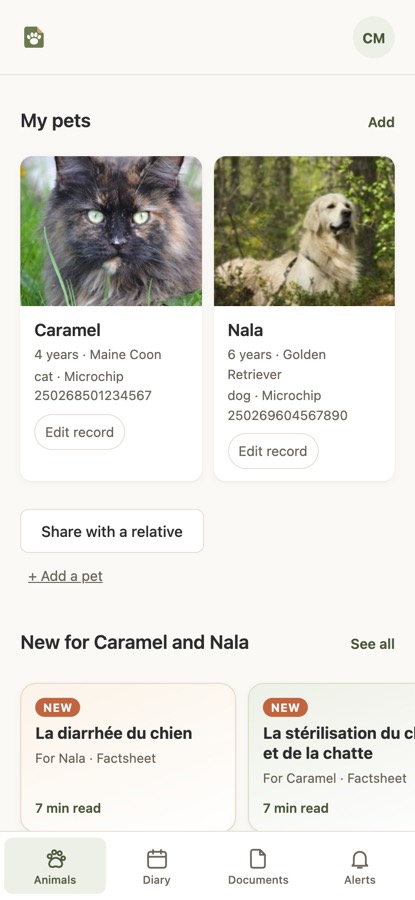
A cat's paperwork does not keep well between visits: the invoice for the neutering sits in an inbox, the kidney blood test results in an envelope, and the kitten's booklet is still at the breeder's. The app gathers them into a single record, filed by category, from prescriptions to insurance claim forms.
Your clinic sends a document from its reception desk, with your mobile number as the only address; if you did not have a record yet, it is created there and then. The clinic can also write to your record address, firstname.lastname@vetodossier.com (how it works, in French). You approve the sender the first time. After that, their attachments arrive in your record: on your cat's page if it is the only animal on your account, otherwise in “To sort”, where you choose the cat. Everything else you photograph with your phone, one page at a time, and a PDF that came by email can be uploaded from the phone without taking a photo.
One tap opens the document in the phone's viewer. “Forward” hands it to the share sheet, and the prescription goes to the cattery looking after your cat while you are on holiday, or to the person who comes in to feed it.
Who fills in a cat's health record, the vet or you?
In a paper booklet, the vet does the writing and stamps each vaccination. In the app, both you and the clinic write, and every item says where it came from. A document sent by a clinic carries that clinic's name; what you upload carries “Added by you”, and anything that comes in through the record address shows “Received by email from” followed by the sender. A vet opening the record sees the difference at a glance.
A clinic's document cannot be edited: its name, category and date come from the clinic. You can rotate it, forward it or remove it from your record. Your own uploads can be renamed and filed however you like, and they never pass for the vet's work.
Cat health tracking: dated weight, treatments, reminders
Between appointments, weight is about the only measurement you can take at home, and a few hundred grams matter on a four-kilo animal. The app never shows a weight without the date it was taken: you read 4.2 kg, then “Weighed on 3 November 2026”, and deleting the weight deletes its date.
The treatments you declare are recorded with the product name, the number of doses a day and the duration, or as a long-term treatment; wormers and flea and tick treatments are entered the same way. Vaccine booster reminders set by your clinic go into the diary alongside your appointments, and your record reminds you of them. Which vaccines your cat needs against cat flu (in French), panleukopenia, feline leukaemia or rabies, and how often, is a decision for you and your vet, depending on whether your cat goes outdoors. Our guide to cat vaccinations (in French) summarises the published recommendations.
Neutering is often the first operation of a cat's life (our neutering guide, in French). The surgical report is filed under “Procedure”, the invoice under “Invoice”, and you can add the date of the operation to the medical history on the emergency card. If the clinic has tested your cat's blood type, note it down with the date and the clinic's name.
An emergency card for your cat, with its QR code
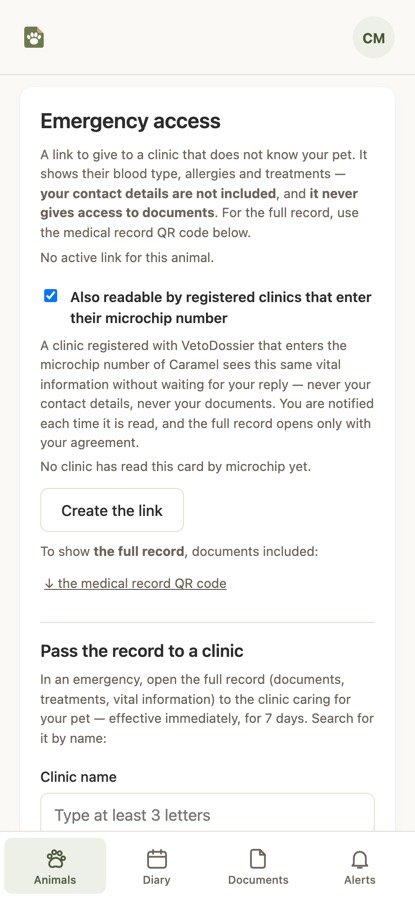
A cat that goes out comes home limping one evening, or does not come home at all and ends up at a vet who has never seen it. The emergency card fits on one page: blood type, allergies, medical history, weight and its date, current treatments, usual vet. For a cat, the app offers A, B or AB, and “Not provided” until you know; it never writes “nothing to report” in place of an empty box. The blood type says when and where it was tested, or that it was declared by you and not verified; the weight and treatments say whether they came from you.
Scanning its QR code or following its link opens the card, and nobody needs an account to read it. The QR code goes on the collar tag, or in the pocket of the carrier for a cat that does not wear a collar. Your name and phone number are not on the card. Its “Prévenir le propriétaire” button (the card is shown in French, and the words mean “alert the owner”) sends an alert to your record without giving away your contact details. You can see how many times the card has been opened, and when. A clinic registered with VetoDossier can type in your cat's microchip number and read the same card at once; you are told when that happens, and you can turn this off from your cat's page. What belongs on the card, and what is better left off, is covered in our emergency card guide (in French).
The record follows your cat, and you can open it as a vet would
Your cat's medical record does not belong to any clinic: it goes with you when you move house, and to the out-of-hours vet. A clinic registered with VetoDossier can ask for access to the record using the microchip number. You grant it from the app, you withdraw it whenever you like, and the log tells you when the record was opened. For an out-of-hours vet you will not see again, you give a seven-day link that opens the record without an account; the record's QR code, made before you set off, stays on the phone even without signal. The consent that governs this access is described on the shared medical record page (in French).
The microchip number is the key to this record. In France, identification is compulsory for any cat over seven months old, and for any cat sold or given away, whatever its age. It is carried out by a vet (or, for a tattoo, by an approved tattooist), and the animal is entered on the national register kept by I-CAD. Our microchip number guide (in French) explains what the number is for.
The demonstration record shows what the vet reads: open Pistache's record (in French), or scan the QR code below. Pistache is a fictional cat, but her record is complete: microchip, blood type, an allergy, medical history, a declared treatment, her spaying and eight documents sent by a demonstration clinic. It opens without an account and, apart from the banner saying the animal is fictional, it is the page a vet or vet nurse receives.

On Android, on iPhone, in a browser
The Android app is on Google Play and the iPhone app on the App Store. For now both are in French, and they are published on the French App Store and Google Play: with an Apple or Google account from another country, you may not find them. In English, the record opens in any browser, on a computer or a phone, at vetodossier.fr/carnet. The apps and the browser open the same record, with the same account and the same documents. You sign in the same way everywhere, with your phone number or email and a password; a new device asks once for a code sent by email.
VetoDossier is free, for owners and clinics alike. You can export your whole account, or delete it, from your record.
In short
- The clinic's documents arrive from its reception desk or through your record address; you photograph the rest, one page at a time.
- Every item says where it came from: the clinic's name, “Added by you”, or the sender of the email.
- The weight is shown with the date it was taken; the emergency card opens without an account and does not show your contact details.
- A clinic's document cannot be edited. The record's QR code is made before you set off and works without signal. It is all free, in any browser and in the Android and iPhone apps (in French for now).