 VetoDossier
Dog health record app: your dog's record in your pocket, free
Practical guide Updated 8 November 2026 · Sources: service-public.gouv.fr, I-CAD, French Ministry of Agriculture
VetoDossier, the shared medical record for pets, also works as an app for your dog. It keeps in your pocket what the paper booklet leaves at home: the documents your clinic sends you, your dog's emergency card and its reminders. You have nothing to copy out: the clinic sends, and the record does the filing.
The iPhone and Android apps (App Store, Google Play) are in French for now; the English version works in any browser, including on your phone.
Why a dog's health record needs to leave the house
A dog doesn't stay at home. It goes out on walks, spends nights at the boarding kennels, gets into the car for a weekend away, and now and then ends up at an out-of-hours vet on a Sunday evening. Each time, someone asks for a piece of paper: the vaccination record at the kennels, the passport at a border, the latest prescription at the emergency clinic. The paper booklet, meanwhile, is still in a drawer.
Two of those papers are compulsory. Identification comes first: in France, a dog must be identified by microchip or tattoo once it is over four months old, and at any age before it is sold or given away. The identification is entered in the national register of domestic carnivores, which I-CAD keeps. Then comes the passport, if your dog travels within the European Union: a vet issues it to a dog that carries a microchip (a legible tattoo done before 3 July 2011 is still accepted) and has been vaccinated against rabies, and the vaccination only counts from 21 days after the injection. Our guides to the microchip number (in French) and to the European pet passport (in French) explain what each of these papers covers. A dog that falls into one of France's categories of potentially dangerous dogs has obligations of its own, set out in the guide to category 2 dogs (in French).
What the app shows: the documents your clinic sends
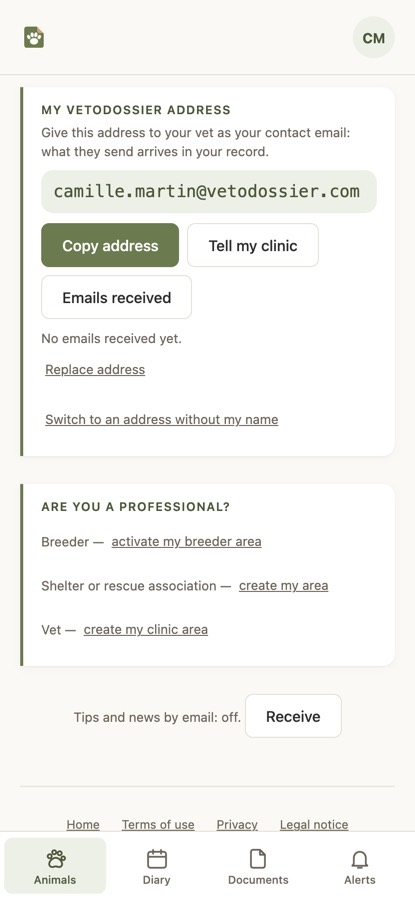
The record address. Your record has its own email address, in the form firstname.surname@vetodossier.com. You give it to your clinic as your contact address, in place of your own. When the first message arrives, the app asks you to approve the sender; after that, any invoice or report the clinic sends goes into your record, on your dog's profile if it is your only animal. If you have several, you choose the profile when you sort the document. The clinic has nothing to change: it sends an email, as it always has. The details are on the record address page (in French).
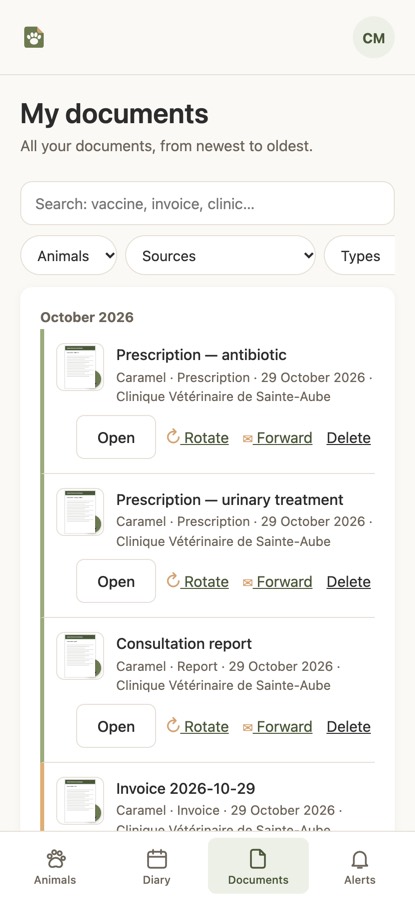
Sent with your phone number. If your clinic uses VetoDossier, it doesn't even need the address: from its clinic area, it sends the document using only your phone number, and the document arrives dated and filed under its category: prescriptions, reports, lab results, imaging, vaccinations, procedures, invoices and insurance claim forms. Each arrival shows up in the app's Alerts tab. The documents themselves stay as the clinic wrote them, so a French prescription remains in French.
Your own papers. The puppy's booklet, the breeder's certificate, a prescription from another clinic: you photograph them with your phone, page by page, or upload the file. Documents you add are marked “Added by you”, and those that reach your record address “Received by email from…”. A vet reading the record can see at a glance what a clinic sent through VetoDossier and what came in through you.
Open shows the document on your phone; Forward brings up the phone's share sheet, so the insurance claim form goes to the insurer by Mail and the vaccination page to the kennels by WhatsApp.
A medical record that follows your dog from clinic to clinic
The vet on duty that Sunday has never seen your dog. Nor has the vet in the town you are moving to, or the specialist who will operate on its knee. No record passes between them, apart from the one you bring. With VetoDossier, a registered clinic asks for access to your dog's record by entering its microchip number; the request reaches you in the app and you decide. Until you answer, the clinic sees nothing; once you accept, you can see when the record was opened, and you can withdraw access whenever you like. How it works, and the log it keeps: the shared medical record (in French).
If a vet doesn't use VetoDossier, you still have two ways to share the record: show them the medical record QR code, or send them its link. Both last seven days and open the full record without a login. If you change vets, the record goes with you: our guide to changing vets (in French) explains how.
The record as a vet receives it
Rather than describe it, open it. The link below shows, with no login, the full record of an animal that does not exist, as a vet reads it when it is shared by link or QR code: vital information, microchip number, treatments, then the documents from a demonstration clinic, section by section. The animal is a cat, made up for the example; a dog's record reads the same way. A banner at the top of the page says so. The demonstration record itself is in French.
Open the demonstration record (in French)
Your dog's emergency card and its QR code
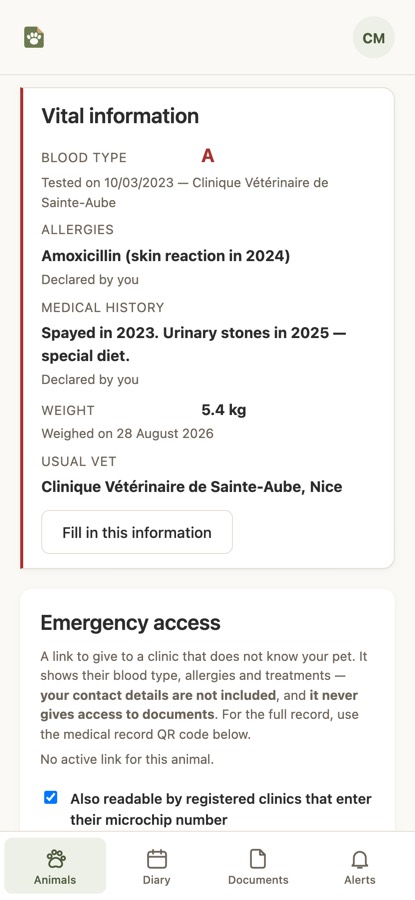
A passer-by finds your dog after it has been hit by a car and carries it to the nearest clinic. Within a minute, the vet needs three things: its blood type if it has been tested (DEA 1 positive or negative), its allergies and its current treatments. The QR tag on its collar leads to the emergency card, which shows all three, along with its medical history, its weight and the date it was weighed, and the name of its usual vet. Allergies, history and treatments you entered yourself are marked “Declared by you”. A clinic registered with VetoDossier that types in its microchip number reads the same card straight away; you are notified, and you can turn that off from your dog's profile.
The card opens from a link or a QR code, without signing in, and the QR code is made for the tag: it does not reveal your name, phone number or address, or any document, since anyone at all can read a tag. The card itself is displayed in French. The guide to the emergency card and its QR code (in French) goes through what it contains, line by line.
Keeping track of your dog's health: your record reminds you of vaccines and treatments
The vaccine booster your clinic noted down, the doses of a course of treatment, the flea and tick treatment you logged before tick season: your record reminds you of them. The diary gathers the appointments and reminders your clinics have entered, and treatments you declare yourself are kept apart from those a vet has prescribed. Which ones, and how often, is for your vet to decide; the record only remembers the date.
Free, in any browser, on Android and on iPhone
VetoDossier is free, for owners and for clinics. If that ever changes, you will be told beforehand. The English version runs in any browser, on a computer or a phone. The apps, in French for now, are on Google Play for Android and on the App Store for iPhone. They are published on the French stores, and may not appear for a store account registered in another country.
It is the same record as on the web, with the same account: you sign in with your phone number or email and your password, and a code is sent to you by email the first time you sign in on a device we don't recognise. You can export all your data, and delete your account, from the record. If you prefer paper, the printable dog health record (in French) has the same sections in a PDF.
Key points
- The app receives what your clinic sends, through your phone number or your record address; anything else you add as a photo, marked “Added by you”.
- The record follows your dog: a registered clinic asks for it with the microchip number and you decide; for any other vet, there is the medical record QR code or a seven-day link.
- On the collar tag, the emergency QR code gives the vital information, without your contact details and without any document.
- It is free and in English in any browser; on Android (Google Play) and iPhone (App Store) the app is in French for now, with the same account as on the web. The originals of the identification document and the passport are still the ones to keep.